

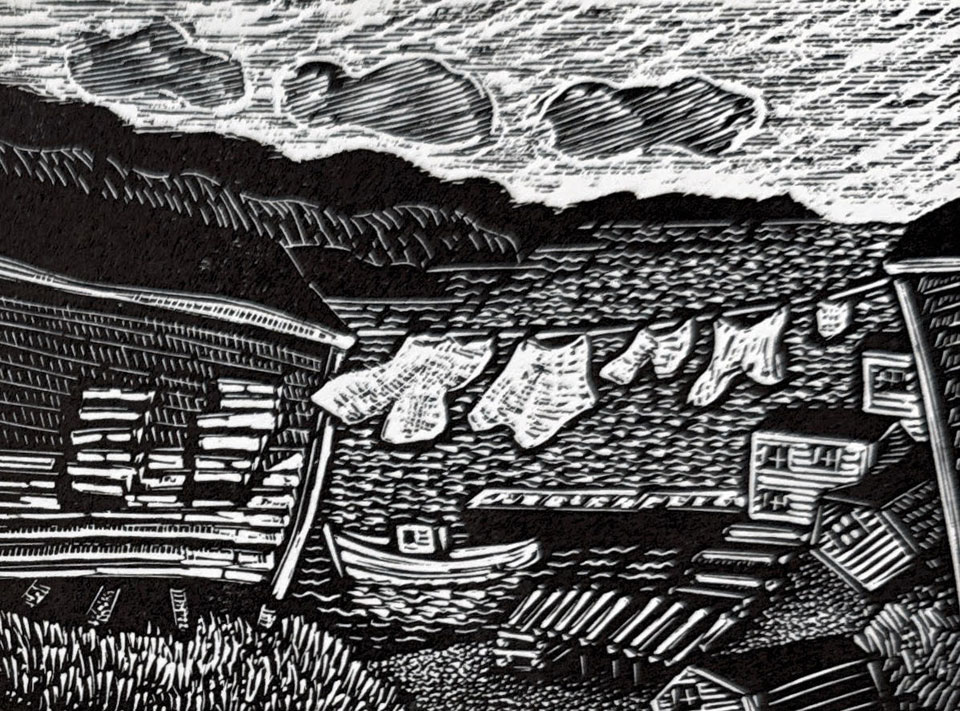
“Oh Bonaventure, your hills will always keep me from all harm” from Sweet Bonaventure by poet Des Walsh. A wood engraving by Alan Stein.
Throughout my life, I have accumulated an extensive collection of artwork. On various occasions, within national organizations to which I am affiliated, artwork exchanges have taken place, resulting in a significant number of smaller pieces. Also, several decades ago, I began reproducing one of my paintings each year as the cover for my Christmas cards. Throughout the years, this practice has resulted in my receiving numerous comparable cards from various artists with whom I am acquainted—specifically, several dozen. Many were produced using traditional printing presses while others are unique, hand-made prints, such as those from Fred Hummel, Alan Stein, Heidi Burkhardt, Jiri Ustohal, Valerie Ceponis, among others. Although these works are modest in size, they are undoubtedly treasured pieces. Collectively, regardless of production technique, they represent a considerable visual record of our era and its artist contributors.
In my sunroom, there is a dedicated wall showcasing an evolving collection of hand-carved masks representing diverse indigenous origins. This includes examples from Papua New Guinea, British Columbia’s Northwest Coast, Bali (Indonesia), a “Green Man” carving from Quebec, and another likely originating from the Himalayas or Tibet, distinguished by its third-eye motif and exaggerated teeth. The collection invites a global journey from the comfort of one room.

The house walls are also adorned with framed works by a range of accomplished Canadian artists, including Tony Batten, Maryanne Ludlum, Rayne Tunley, Fred Brigden (father and son), Ray Cattell, Debbie Wyles, Roy Wright, Linda Kemp, John Joy, Maurice Snelgrove, Tim Packer, J.W. Beaty, Michael Cleary, Les Tibbles, Mark Ruchlewicz, and many more. Pieces awaiting framing are stored in architectural cabinets, preserving the works of Brent Townsend, Barb McGuey, Simon Ng, William Rogers, Mark Rosser, Jeanette Langlois Labelle, Vera Bobson, George Todorovski, and many others.
Reflecting on the motivations behind becoming an art collector, I recognize that it is often an appreciation of artistic beauty, admiration for technical achievement, or recognition of historical significance that drives acquisition decisions. Occasionally, a piece resonates personally or simply appeals aesthetically. Regardless of the specific reason, the result is a distinguished and meaningful collection.

Additionally, my own artwork and that of my wife, Wendy, require systematic cataloguing, photography, measurement, detailed description, and location documentation—an undertaking involving hundreds of drawings and paintings.
Consequently, I have embarked on the substantial task of archiving the collection. Key information such as artist attribution, medium, date of creation, image dimensions, support material (canvas, paper, acrylic, oil), and other relevant historical details must be recorded for authentication purposes. Provenance, including the site of creation (e.g., Africa, the Arctic), and visual documentation are critical. While I am an artist rather than a trained archivist, I am committed to performing this work as thoroughly as possible, leaving any additional research to future custodians. The recent controversy surrounding the authentication of Norval Morrisseau’s work underscores the importance of diligent record-keeping to prevent misattribution.
Archiving is an ongoing endeavor constrained by time. Once artists pass away, their direct insights are lost, you can’t ‘get them on the phone’ and get an answer in a flash, which makes posthumous research akin to detective work. Accurate and thorough archiving ensures essential information remains accessible for posterity.
Peter Marsh September 29, 2025


1 Comments
darius.via
Hi Peter,
Wishing you great progress on the archival project! Quick thought – have you reconsidered using a color reference charts to boost relevance of your documentation? McMichael Gallery just highlighted how they use reference charts when digitizing their collections. I have already raised this topic; If it works for them, why not for us?
Happy to discuss the details.
Best, Dariusz
Comments are closed.